


Your personal sales partner
You can find our sales partners in many countries in Europe and North America. If you have any questions, please contact us or one of our sales partners. We also prepare welding samples for you.
The converter turns the electrical oscillation of the generator into a mechanical vibration. NUCLEUS builds converters for 20, 30 and 35 kHz – fixed for presses and custom systems, rotating for roll seam welding.

The converter contains piezoceramic discs. They expand and contract in step with the electrical voltage – tens of thousands of times per second. This turns the electrical signal of the generator into a mechanical vibration that reaches the material via booster and sonotrode. How ultrasonic welding works as a whole is explained in our ultrasonic basics.
A good converter delivers a constant amplitude – even after hours of operation. That decides whether the seam at the end of the shift looks just like the one at the start.
In roll seam welding, the converter turns together with the sonotrode. For this we developed our own rotating converters: the rotary transformer is dust-protected encapsulated (IP51) and integrated directly into the converter. So it works reliably – even where fibres and dust are in the air. For high continuous loads there is the IP61 version with compressed air cooling.
Classic generators are tuned to one fixed frequency. Our NUSonic DG1x generator runs any frequency from 17 to 70 kHz. Whether 20, 30 or 35 kHz – all NUCLEUS converters run on the same generator.
We develop and build generators, converters and sonotrodes ourselves. Because all components are matched to each other, the quality of the welds stays constant. We are happy to discuss which converter suits your application – get in touch with us.

The powerful converter for large parts and large sonotrodes. Its flange allows fixed installation in presses and custom systems – for example for welding collars and flanges onto filters.
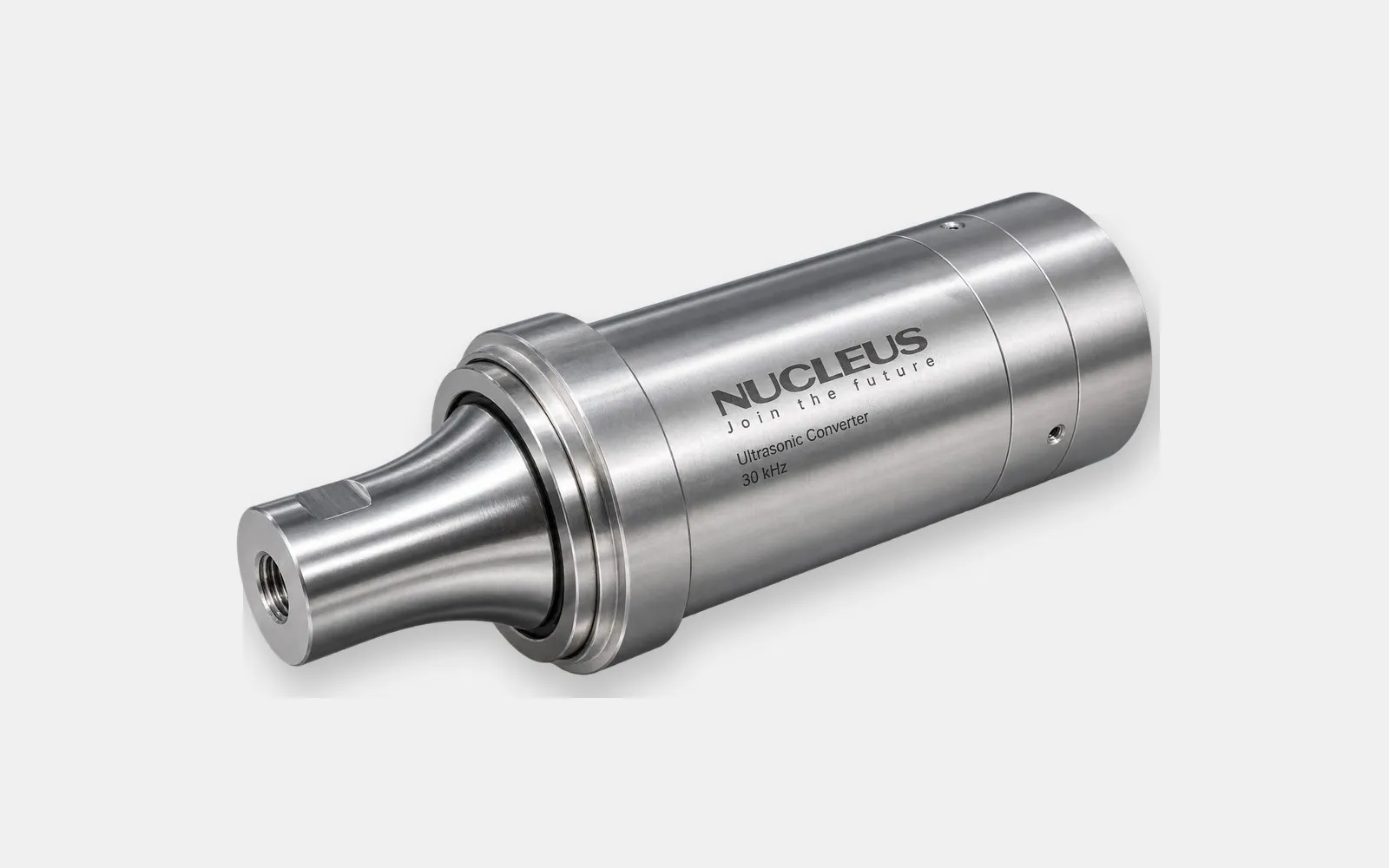
The middle ground between power and compactness. The 30 kHz converter suits medium-sized parts and applications where space for the vibration system is limited.

Our converter for rotary ultrasonic welding. The encapsulated rotary transformer keeps dust out, even though the converter turns constantly. Optionally available as an IP61 version with compressed air cooling.
| Frequencies | 20, 30 and 35 kHz |
|---|---|
| Versions | fixed (flange or ring mounting) and rotating |
| 35 kHz rotating series | KR35-1200, KR35C-1200 |
| Rotary transformer | dust-protected encapsulated, IP51 |
| Option | IP61 version with compressed air cooling |
| Matching generator | NUSonic DG1x (17 to 70 kHz) |
The converter – also called transducer – turns the high-frequency electrical voltage of the generator into a mechanical vibration of the same frequency. It passes this vibration on to the material via booster and sonotrode.
As a rule of thumb – the larger the part and the more power is needed, the lower the frequency. 20 kHz suits large parts, 35 kHz suits textiles, nonwovens and films in roll seam welding. We are happy to advise you and test your material in our sample laboratory.
The converter generates the mechanical vibration. The booster adjusts its amplitude. The sonotrode transfers the vibration into the material. All three must be tuned to the same frequency.
Not in normal operation. For high continuous loads or warm surroundings, our 35 kHz converter is available as an IP61 version with compressed air cooling.
Yes. We supply converters for NUCLEUS machines as spare parts. Just give us the machine or article number – we will get back to you with delivery time and a quote.

You can find our sales partners in many countries in Europe and North America. If you have any questions, please contact us or one of our sales partners. We also prepare welding samples for you.